



Between inflation and the rising minimum wage, labour costs are rising for retailers. This means it’s more important than ever to find ways to optimize your labor management and reduce costs.
At Shiftlab, we can help you do more with your budget and team. Here are six powerful ways retailers can reduce labor costs with Shiftlab.
6 Ways to Save on Labor Costs with Shiftlab
1. Use Data-Driven Insights to Make Your Schedules
One of the most common reasons for higher labor costs is inefficient scheduling.
According to Peeysh Pandey, Hasmukh Gajjar, and Bhavin J. Shah, authors of a 2021 study, “Determining optimal workforce size and schedule at the retail store considering overstaffing and understaffing costs,” “Inefficient staffing and scheduling of workers usually result in higher understaffing and overstaffing costs for the retailers due to varying demand.”
The authors continue, explaining that “In understaffing, retailers face sales and goodwill loss and receive negative feedback due to unsatisfied customers. On the other hand, in overstaffing, retailers incur excessive labor costs.”
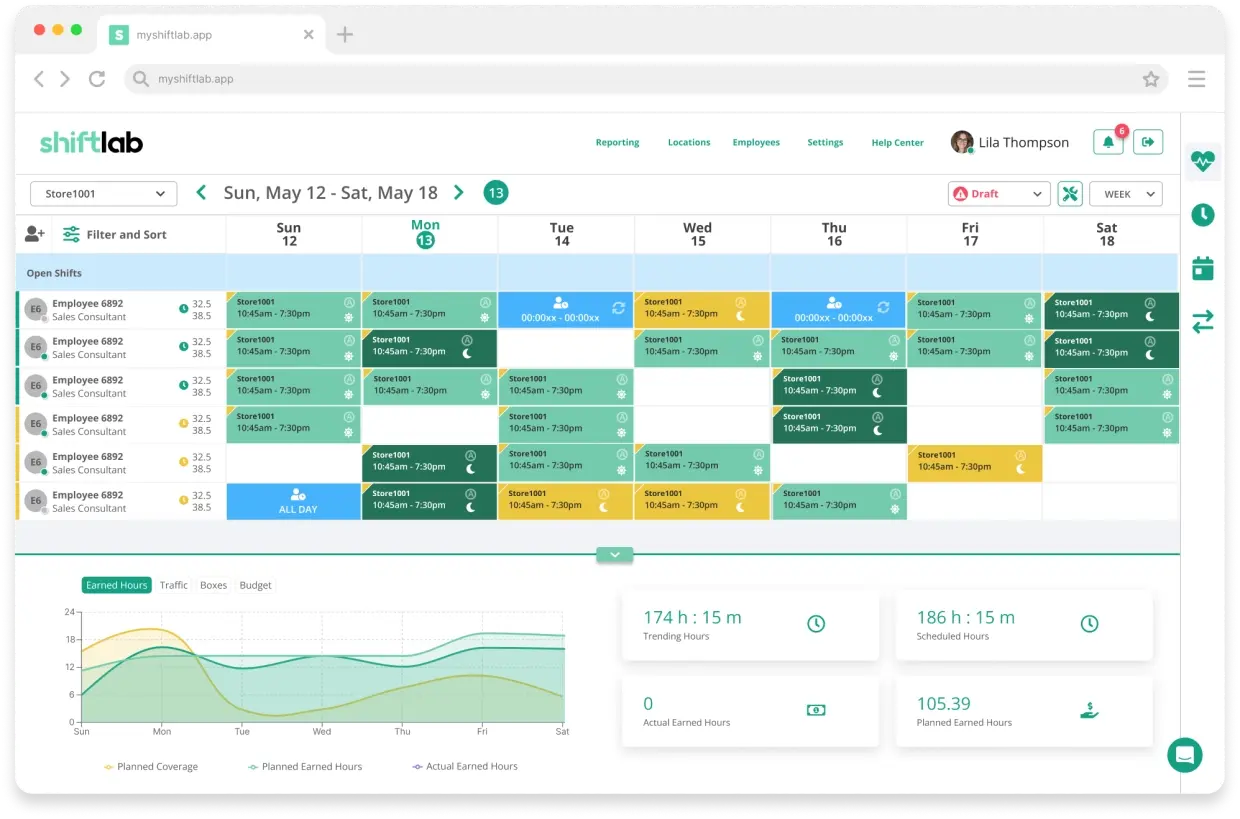
Shiftlab offers a direct solution to this problem. Our workforce optimization tools:
- Use historical and real-time store data to predict staffing needs and provide in-the-moment updates.
- Automatically create schedules based on each employee’s availability and role with built-in labor law compliance, reducing errors and saving (tons of) time.
- Empower employees with the ability to easily swap shifts and claim open shifts on our app—within parameters that you set up beforehand.
- Forecast labor needs with AI for smarter employee allocation during both peak and slow periods. Top performers are placed in prime shifts.
- Simplify compliance and overtime automatically, helping you avoid fines and unnecessary labor costs.
The benefits of our workforce management tools for scheduling go beyond saving money. You’ll notice that you can put power in the hands of individual team members with open shift and shift swap features.
With AI forecasting, you help avoid any instances where your team is either under- or over-staffed.
This balanced approach translates into higher morale and less turnover, both of which help reduce labor costs in the long term.
2. Strengthen Time Clock Accuracy to Prevent Time Theft
Even the most carefully crafted schedule can lead to lost payroll dollars without accurate timekeeping.
One of the most common hidden costs in retail is buddy punching—where one employee clocks in or out on behalf of another.
Buddy punching costs vary, but they’re estimated at $1,560 per employee per year for employers.
That’s a lot of wasted labor spend.
This isn’t usually malicious. Someone might be running late due to traffic and text a friend to clock them in. But since they’re not actually at work, those minutes are a wasted labor cost for your retail business.
And they add up, as we can see from the estimated cost per buddy-punching offender above.
Shiftlab solves the buddy-punching problem for you with our built-in time-clock features. Our Time Clock app—which integrates seamlessly with our entire scheduling platform—prevents early clock-ins with:
- Biometric fingerprinting integration. Use biometric data to make sure buddy punching can’t happen—period.
- Start time/clock-in restrictions. Employees can only clock in when they’re scheduled to start their shift.
- Real-time notifications for managers. They’ll see when stores open, how overtime is trending, and whether staff have missed punches or breaks.
- Automated punch corrections. Employees forget to punch out? No problem. Shiftlab will automatically adjust those punch-outs to the correct times.
- Track labor vs. sales. See how your labor costs stack up against store sales so you can make adjustments as needed.
Outdated tools like Excel can’t keep up with these features. If you’ve been relying on spreadsheets, it’s time to make a change and save money with a dedicated workforce optimization tool.
3. Empower Employees to Take PTO and Swap Shifts Easily
Creating a workplace culture where paid time off (PTO) is easy to take and encouraged by management comes with documented benefits.
A study by Cleveland State University and Florida Atlantic University found that flexible scheduling and PTO availability significantly reduce turnover.
Overall, offering PTO can reduce the likelihood of quitting by 35%, with a larger difference for men (41%) than for women (25%). But offering flexible scheduling also plays a huge role, particularly for women, who find it just as valuable as popular benefits like PTO and tuition assistance.
With our labor optimization tools, Shiftlab makes it easy for your company to offer both flexible scheduling and PTO.
Here’s how:
- Self-service PTO requests. Employees can request time off from directly within the Shiftlab app—and managers can approve with a quick click. (The schedule automatically gets updated, too!)
- Automated coverage. Open shifts created by PTO—or call-outs—are visible to the employees qualified to claim them. This reduces issues with last-minute coverage.
- Smart scheduling rules. Built-in guardrails prevent any scheduling conflicts and ensure compliance with both labor laws and your company policies.
- Clear visibility for managers. Managers can easily see who’s out, who’s covering for them, and the day's overall staffing.
With these workforce optimization tools, Shiftlab helps reduce labor costs tied to turnover and absenteeism—plus build a culture of trust and flexibility.
Both of these benefit employees and retailers alike.
4. Forecast the Labor You’ll Need with AI
One of the biggest challenges you’ll face in retail is predicting how many people you’ll need on the floor at any given time.
There are tons of variables to consider, from holidays and sales promotions to weather patterns.
Shiftlab helps you avoid relying on guesswork—which can bloat labor costs with overstaffing or cause missed sales opportunities from understaffing.
Shiftlab’s AI-driven forecasting can analyze historical sales, transaction volumes, store traffic counts, promotions, seasonal influence, and external drivers.
We do this through our integrations with major POS systems and retail traffic systems.
5. Standardize Management Across Multiple Stores
When retailers have multiple locations, one of the most significant labor cost challenges is inconsistency across those locations.
It’s a lot to keep track of.

Shiftlab eliminates fragmented approaches to running multiple locations by giving retailers a central platform to manage labour across the entire organization.
So, instead of relying on spreadsheets—or systems that vary from store to store—your leadership can see scheduling, PTO, shift swaps, and overtime patterns across locations.
Here’s what this standardization looks like in practice with Shiftlab:
- Unified scheduling rules. Make sure every store follows the same PTO, overtime, and shift swap guidelines.
- Central dashboard. See labor costs and scheduling patterns across all locations in one dashboard.
- Benchmarking performance. Compare each store’s labor efficiency to spot outliers and apply best practices where needed.
- Cross-store flexibility. Broadcast open shifts across nearby locations to give store employees more flexibility—and create fewer opportunities for overtime.
Bringing all scheduling and labor practices under one roof can help multi-store retailers cut costs, reduce risk, and make sure each store operates at its best.
6. Hit Compliance and Overtime Goals—Every Time
Labor laws are incredibly complex. Even if you have one store, laws are coming at you from multiple sides: the city, county, state, and federal levels, for instance.
With a multi-location store, the complexity multiplies.
Yet failing to follow these rules—even unintentionally—can bring penalties from costly fines and lawsuits to reputational damage that can cost you business.
Overtime is another common drain on labor budgets. While it’s sometimes necessary, overtime can often happen because of poor scheduling practices rather than actual business need.
For instance, a manager could miss that an employee has already hit their weekly limit. Or they might fill last-minute callouts with the same people repeatedly. The result is ballooning payroll costs.
Shiftlab offers tools to help make compliance and overtime management automatic, including:
- Compliance safeguards. Prevents schedules that violate labor laws, such as missed breaks or too many consecutive hours.
- Proactive alerts. Notifies managers before a compliance issue happens (like if an employee fails to take a required break).
- Overtime tracking. Monitors employee hours across the week and flags when someone is approaching their limit before overtime kicks in.
- Suggestions for alternative coverage. Helps managers avoid costly overtime by suggesting other qualified staff who can cover open shifts.
This proactive approach to workforce management optimization helps avoid costly compliance errors and reduce payroll inflation, too.
Start Saving on Labor Costs with Shiftlab
Labor optimization is easy with Shiftlab. Here are the key takeaways from this guide to reducing labor costs for retail businesses:
- Smarter scheduling saves money. With data-powered insights, you can automatically align staffing with actual demand so you never have too many people on the clock—or too few.
- Accurate time clocking cuts waste. Preventing buddy punching and correcting missed clock-outs gets rid of labor costs related to time theft.
- Flexible scheduling lowers turnover. Making PTO requests and shift swaps easy helps reduce the likelihood that your employees will want to quit.
- AI forecasting reduces errors. Integrating your sales, traffic, and seasonal data into scheduling helps allocate your staff where they’ll make the most impact.
- Standardization creates consistency across multiple locations. Retailers with more than one store location should be able to manage labor practices across stores from one central location—and with Shifttab, they can.
- Compliance saves on labor costs. With Shiftlab’s automated compliance tracking, alerts, and overtime monitoring, you can avoid fines and unnecessarily high labor expenses.
Ready to see what Shiftlab can do to help reduce labor costs in your retail business? Schedule a free demo with our friendly team today.

.webp?width=352&name=Blog_featured_images_(OT%20rule%2c%20retail%20KPIs%2c%20shift%20swap).webp)